
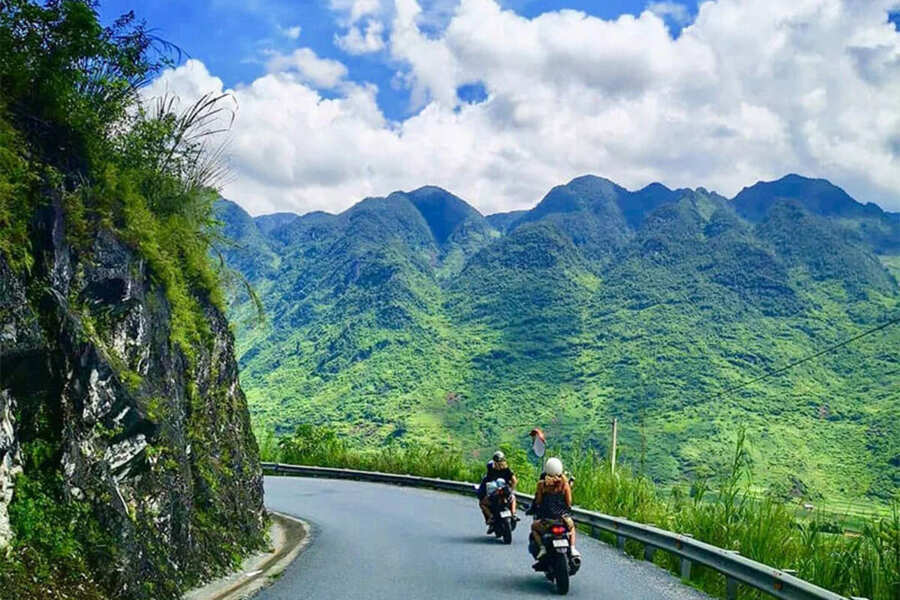

The Ha Giang Loop is, without qualification, one of the most spectacular motorcycle journeys in Southeast Asia. The route covers approximately 350 kilometres through Vietnam’s northernmost province, winding through the Dong Van Karst Plateau Geopark — a UNESCO Global Geopark of limestone peaks, sheer-sided gorges, and valleys so deep that the floor is invisible from the road above. Nothing in the country, and very little anywhere in the region, prepares you for the scale of what the Ma Pi Leng Pass delivers: a sheer cliff road carved above the Nho Que River, with emerald water far below and China visible in the distance.
As adventure-focused Vietnam local tour packages become increasingly popular, Ha Giang has emerged as one of the country’s most sought-after destinations for travellers looking beyond the standard tourist circuit and into more authentic highland experiences.
This guide covers everything that shapes whether a Ha Giang Loop trip goes well or poorly: how to get there from Hanoi, which travel format actually suits your riding ability and trip length, what the permit situation really requires in 2026 – 2027, how to read the seasonal windows, and what the key stops look like on the ground rather than in photographs. The Ha Giang Loop rewards planning. It also punishes overconfidence about road conditions and personal riding ability. Both things are true, and this guide treats them accordingly.
What Makes the Ha Giang Loop So Famous?
Ha Giang province covers 7,900 square kilometres of Vietnam’s far north, sharing a border with China’s Yunnan province. The Dong Van Karst Plateau Geopark — which accounts for 2,356 square kilometres of the province’s interior — was designated a UNESCO Global Geopark in 2010 in recognition of its geological formations, some of which date back 400 to 600 million years to a period when the entire plateau was submerged under a shallow tropical sea.
The loop route itself runs from Ha Giang City through Quan Ba, Yen Minh, Dong Van, and Meo Vac before returning via Du Gia. The full circuit covers approximately 350 kilometres of mountain road, with a total elevation gain of around 4,000 metres across the complete route. The landscapes shift dramatically between sections: the Quan Ba area is characterised by lush valleys and the twin limestone hillocks known as the Fairy Bosom Mountains; the Dong Van plateau opens into a high, rocky plain where the geology dominates and villages appear as small clusters against an enormous mineral landscape; the Ma Pi Leng Pass section drops toward the Nho Que River gorge in a series of switchbacks that most travellers identify as the single most dramatic road they have ridden anywhere.
What has accelerated Ha Giang’s international profile in the past five years is a combination of social media circulation, improved road surfaces on parts of the route, and a growing infrastructure of hostels and tour operators in Ha Giang City that have made the logistics accessible to travellers who would not have attempted the journey a decade ago. The route has appeared widely on TikTok and Instagram since 2022, driving a significant increase in visitor numbers — though Ha Giang remains meaningfully less crowded than Sapa, and the experience of riding the Ma Pi Leng Pass without another vehicle in sight remains entirely possible outside peak season.

How to Get to the Ha Giang Loop from Hanoi
Ha Giang City does not have a commercial airport. The standard arrival route from Hanoi is a 6 to 8-hour bus journey covering approximately 300 kilometres north from the capital.
The overnight sleeper bus is the most common and cost-efficient option. Buses depart from Hanoi’s Old Quarter or from My Dinh Bus Station between 9:00 PM and 11:00 PM and arrive in Ha Giang City between 4:00 AM and 6:00 AM. Fares range from VND 200,000 to VND 400,000 per person (approximately $8 to $16 USD) depending on the operator and seat type. Most hostel-linked operators offer hotel pickup from the Old Quarter, which is worth the convenience when boarding with a backpack late at night. Booking in advance is advisable during October and November when demand is highest.
For travellers who prefer daytime travel or have motion sensitivity on mountain roads, VIP limousine minivans run throughout the day with air conditioning and more comfortable seating. These take 5 to 6 hours and cost VND 350,000 to VND 500,000.
The return journey from Ha Giang to Hanoi follows the same route and costs approximately the same. Many travellers choose to extend their northern Vietnam circuit by continuing from Ha Giang to Sapa (approximately 5 to 6 hours, around 200 kilometres) rather than returning directly to Hanoi.
How Many Days for the Ha Giang Loop?
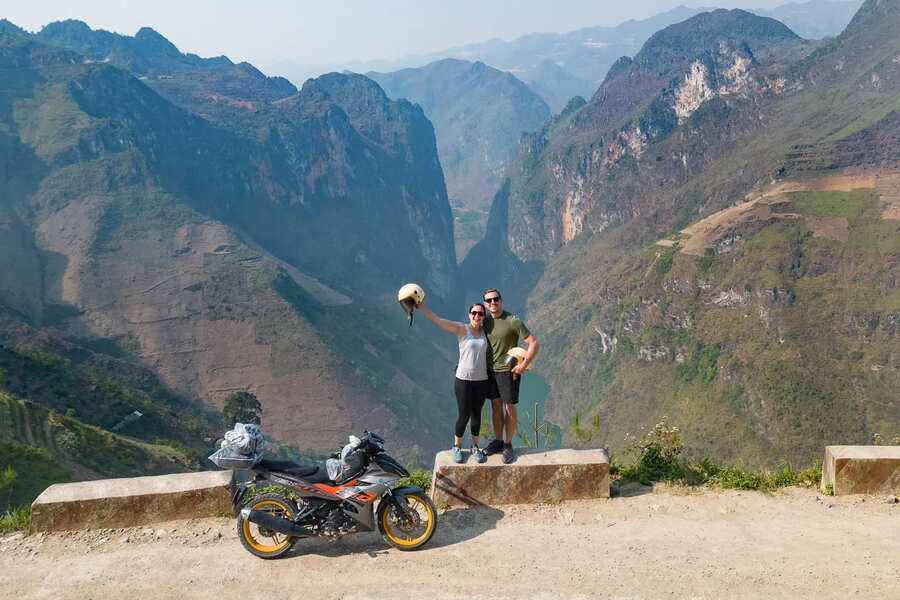
The loop is physically possible to complete in two days if you are willing to ride 6 to 7 hours per day and skip detours and slower stops. However, two days produces a rushed, highlight-only experience that most travellers who have done it say they regret — you reach the scenic viewpoints but miss the cultural dimension that makes the loop genuinely distinctive.
The recommended durations and what each delivers:
3 days: The minimum that covers all major highlights at a reasonable pace. Daily riding of 4 to 5 hours with stops at Quan Ba Heaven Gate, Tham Ma Pass, Lung Cu Flag Tower, Dong Van Ancient Town, Ma Pi Leng Pass, and Meo Vac. This is the most common format for independent travellers on tight schedules. Pace is brisk and there is limited time in any one place.
4 days: The format recommended for most travellers. Adds the Du Gia waterfall section to the route, allows time at Meo Vac’s Sunday market (which is the most culturally significant market on the loop, where Hmong, Tay, and Lo Lo vendors descend from surrounding villages in traditional dress), and reduces daily riding to a more comfortable 3 to 4 hours. The Hmong King’s Palace — Vuong Chi Sinh’s residence at Lung Cu — receives the attention it deserves at this pace.
5 days: Suited to travellers who want to include a Cao Bang extension or spend additional time in specific villages doing homestay cultural experiences. The loop is not rushed at 5 days and allows for the kind of spontaneous diversions — following a road that looks interesting, stopping at a village because music is coming from inside — that make the difference between a great trip and a memorable one.
The 3-day option is the most commonly sold by Ha Giang tour operators. The 4-day format is what most experienced travellers recommend when asked retrospectively.
Ha Giang Loop: Self-Drive or Easy Rider?
The most consequential decision for any Ha Giang Loop trip is how you travel it, and this decision depends on your riding experience, your comfort with route-finding, and your legal situation with regard to Vietnamese driving regulations.
As of 2026 – 2027, Vietnamese authorities have implemented and are enforcing stricter requirements for foreign riders. Legally, self-driving the Ha Giang Loop requires a valid International Driving Permit (IDP) issued under the 1968 Vienna Convention in Category A, alongside a home country motorcycle licence. Fines for riding without a valid IDP have been reported at VND 6,000,000 to VND 7,000,000 (approximately $230 to $270 USD). Enforcement is not consistent across all checkpoints, but it does occur, and the financial and logistical consequences of being stopped without documentation are significant.
For travellers with valid IDP documentation and genuine experience on mountain roads, self-driving is the format that delivers maximum freedom. Motorbike rental in Ha Giang City costs VND 180,000 to VND 500,000 per day (approximately $7 to $20 USD) depending on the model. Semi-automatic bikes of 110cc to 125cc are the most common rental option and are appropriate for the route. Automatic bikes struggle on steep gradient sections and are not recommended. Manual bikes of 125cc to 150cc are the choice for more experienced riders who want more control on technical descents.
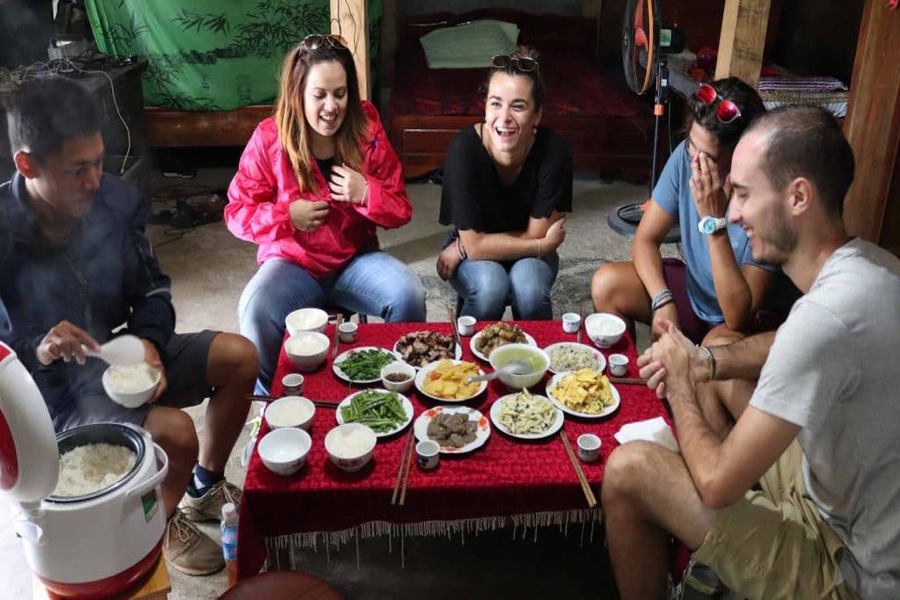
The Easy Rider format — travelling as a passenger on the back of a local guide’s motorbike — resolves the licence issue entirely and adds a culturally significant dimension to the trip. A skilled Easy Rider guide will speak English, know which villages are worth stopping at, translate interactions with locals, point out geological and cultural context that a solo rider on their own maps will entirely miss, and ensure that the logistical difficulties (accommodation, route variations, mechanical issues) are handled without consuming the traveller’s attention. Easy Rider packages for 3 to 4 days cost approximately $130 to $380 USD per person depending on whether accommodation is shared or private and what inclusions are covered. This is not budget travel — but it is a meaningfully different experience from riding alone.
Group tours, typically running in groups of 6 to 15 people, cost $160 to $210 USD for 4 days and represent the most social format. Quality varies significantly between operators. Key factors to confirm before booking: whether the guide speaks English (not guaranteed despite tour descriptions), whether accommodation is private room or dormitory, and the group size (groups above 15 people tend toward a party dynamic that most travellers over 25 find incompatible with the landscape they came to see).
Jeep tours, introduced by some operators in 2026 – 2027, are a genuine and useful addition for travellers who cannot or do not want to ride at all — families, older travellers, or those with physical limitations. Military-style open-top 4×4 jeeps cover the route with complete panoramic views. A 3-day jeep tour starts from approximately $300 USD per person.
Ha Giang Loop Permit Guide
Parts of the Ha Giang Loop route run through Vietnam’s border zone with China, which requires a foreign travel permit for areas including Dong Van, Meo Vac, and the Lung Cu district. This is a border area permit, not a visa — it is a supplemental document that authorises foreign nationals to travel in the restricted zone.
The permit costs approximately VND 200,000 to VND 250,000 per person (approximately $10 USD). It is typically obtained in Ha Giang City the day before riding, either through your accommodation, through your tour operator, or directly at the immigration or police desk on Tran Phu or Nguyen Trai Street. You will need your passport, your Vietnamese visa details, and your motorbike plate number if you have already rented. Processing is usually completed within the same day.
Most organised tours — Easy Rider, group tours, and jeep tours — handle the permit application as part of their service. If you are self-driving, confirm permit status before leaving Ha Giang City, not after you are on the road. Checkpoints are intermittent but do exist near Dong Van and along the Lung Cu approach road, and being stopped without a permit creates avoidable delays.
Enforcement of both the permit and the IDP requirement has increased since 2024. Travellers who did the loop in 2022 or 2023 under the previous lighter enforcement regime should not assume conditions are the same.
Best Time to Visit the Ha Giang Loop
Ha Giang has two strong windows and two periods to approach with clear expectations.
September to November is the premier season, and October is specifically the most iconic month for two reasons: the rice harvest, which turns the terraced valley floors between Quan Ba and Yen Minh from deep green to layered gold, and the buckwheat flower season on the Dong Van Plateau, where the ground cover shifts to pink and white across the high rocky terrain. These two phenomena overlap in October, creating conditions that cannot be replicated at any other time of year. Accommodation in Ha Giang City fills up weeks in advance during peak October weekends — booking a month ahead is not excessive.
March to May is the spring window: temperatures of 15 to 25 degrees Celsius, lower visitor numbers than autumn, and the watering season when terraces are flooded for planting, creating reflective surfaces across the valley floors. This is the better window for travellers who want the landscape without the crowds that October attracts.
June to August is the summer rainy season. Roads become muddy, passes develop slippery sections, and visibility on the highest points is frequently reduced by cloud. Experienced riders with time flexibility can manage this window, but it is not recommended for first-time loop travellers.
December to February is cold — the Dong Van plateau sits above 1,200 metres and night temperatures drop to 5 to 8 degrees Celsius in January, occasionally lower. Roads are generally dry but cold riding at elevation is not comfortable without proper gear. Very few tourists visit during this window, which has an appeal of its own, but the rice fields are empty and the cultural markets are less active.
Best Stops on the Ha Giang Loop
Quan Ba Heaven Gate is the first major viewpoint on the loop, approximately 46 kilometres north of Ha Giang City. The road climbs to a mountain pass from which the Fairy Bosom Mountains — two rounded limestone peaks rising from the valley floor — are visible below. It is the first indication of the geological scale that defines the rest of the journey.
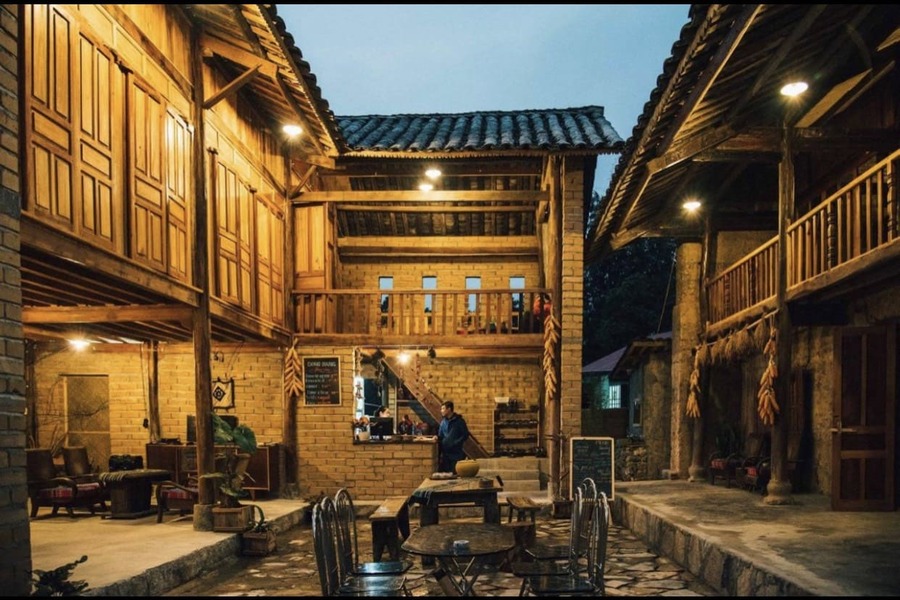
Dong Van Ancient Town is the cultural anchor of the loop. The old quarter of Dong Van contains traditional Hmong and Tay architecture — earthen houses with stone foundations and wooden frames — that has survived in better condition than most comparable mountain towns in northern Vietnam. The Sunday market draws communities from across the surrounding districts. Vuong Palace, the former residence of the Hmong king, sits 3 kilometres outside town in Lung Cu commune and is one of the few surviving examples of early 20th century Hmong elite architecture, built between 1919 and 1928 with Chinese architectural influence.
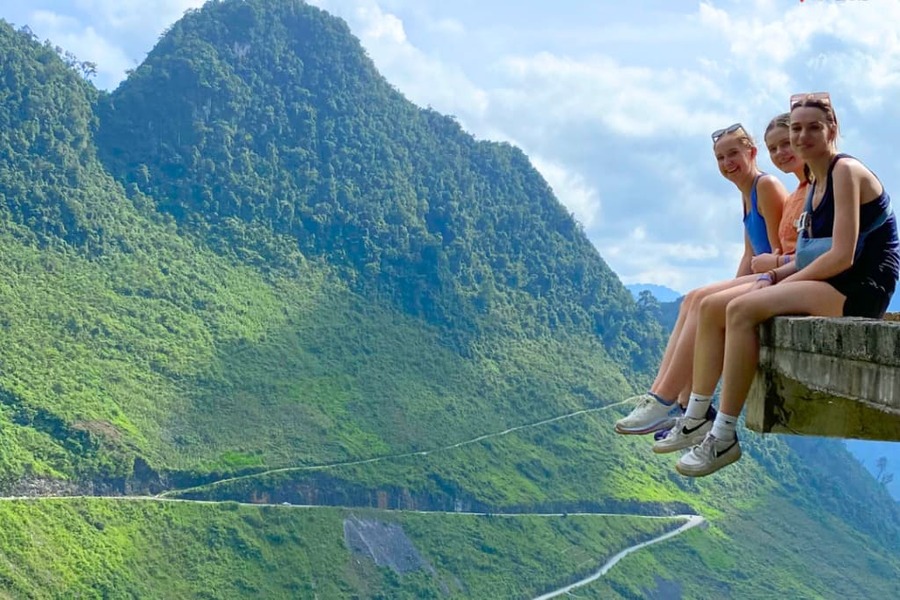
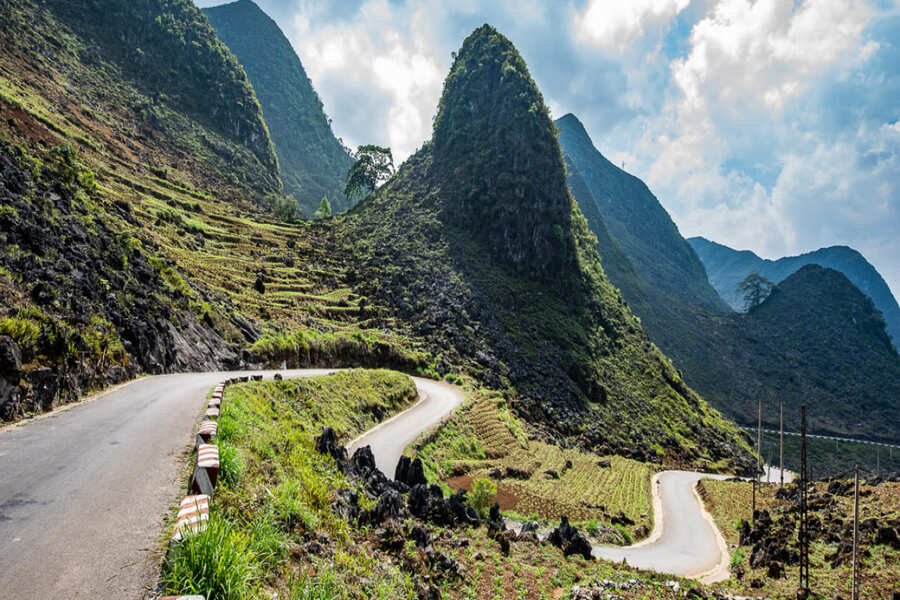
Ma Pi Leng Pass is the moment the loop delivers its most discussed visual. The 20-kilometre section of road from Dong Van to Meo Vac crosses the highest point of the Nho Que River gorge — a canyon up to 800 metres deep carved through limestone by the river. The road is cut directly into the cliff face. There are no barriers on sections of the original road, though newer safety railing has been added to some sections. The Nho Que River below is a particular shade of turquoise that comes from the limestone mineral content of the surrounding geology — a colour that photographs consistently and surprisingly accurately.
Lung Cu Flag Tower marks Vietnam’s northernmost point and sits at 1,700 metres elevation. The climb to the tower involves approximately 400 steps. The Chinese border is visible from the observation platform, and the view on a clear October morning — across the rocky Dong Van plateau, with buckwheat fields in bloom — is the single most striking panorama on the loop.
Meo Vac Sunday Market is the most authentic cultural market on the route. It operates on Sundays and draws Hmong, Tay, Dao, and Lo Lo ethnic minority vendors from villages up to 20 to 30 kilometres away, some on foot with goods carried on their backs. Unlike the increasingly tourist-oriented markets of Bac Ha and Sapa, Meo Vac functions primarily as a local commercial and social gathering. Timing your fourth day to arrive in Meo Vac on a Sunday morning is one of the most effective itinerary adjustments possible.
Essential Ha Giang Loop Travel Tips
Luggage management is a practical issue that first-time loop travellers consistently underestimate. A large 65-litre backpack does not fit on a motorbike and cannot be carried as a passenger on an Easy Rider. Almost every hostel in Ha Giang City offers free and secure luggage storage — leave your main pack at accommodation in Ha Giang City and carry a daypack with 3 to 4 days of essentials. Most passport and valuable item storage is available in hotel safes.
Emergency repair budget of VND 450,000 to VND 1,200,000 (approximately $18 to $50 USD) should be factored into any self-drive trip. Common issues on the route are tyre punctures, which cost approximately VND 150,000 to repair at roadside mechanics available in most district towns, and oil changes at around VND 100,000. Chain issues are the third most common mechanical problem. Familiarise yourself with the bike before leaving Ha Giang City by riding it around the block — this identifies mechanical problems before they occur on a mountain pass.
Travel insurance that specifically covers motorbike accidents is non-negotiable for self-drivers. Standard travel insurance often excludes motorbiking without an explicit endorsement. Confirm your policy’s coverage before the trip, not after a fall on a mountain road.
Mobile data works intermittently across the loop. Offline maps — Google Maps with Ha Giang downloaded, or Maps.me — are essential for self-drivers. Navigation in Ha Giang City and the major towns is manageable, but route-finding between Dong Van and Meo Vac on the minor roads requires offline coverage.

0 Comment