

The best tourist places in Vietnam stretch across more than 1,650 kilometres of coastline, mountain terrain, river delta, and ancient city — and deciding where to go, in what order, and for how long is the first real challenge of planning a Vietnam trip. Vietnam is not a destination you can cover adequately in a few days. It is a country where the north and the south experience different seasons simultaneously, where the food changes dramatically between provinces, and where the gap between a rushed visit and a well-structured itinerary is the difference between ticking boxes and genuinely understanding a place.
This complexity is exactly why many travellers now prefer customised Vietnam travel packages that combine logistics, regional timing, and curated local experiences into a smoother and more rewarding journey.
This guide organises Vietnam’s essential destinations geographically from north to south — the natural direction for most travellers arriving into Hanoi and departing from Ho Chi Minh City, or vice versa. Each entry includes what makes the destination worth the time, how long to spend there, and the specific details that most general guides leave out.
Best Places to Visit in Northern Vietnam for Nature and Culture
Hanoi — Asia’s Leading City Destination in 2026 – 2027
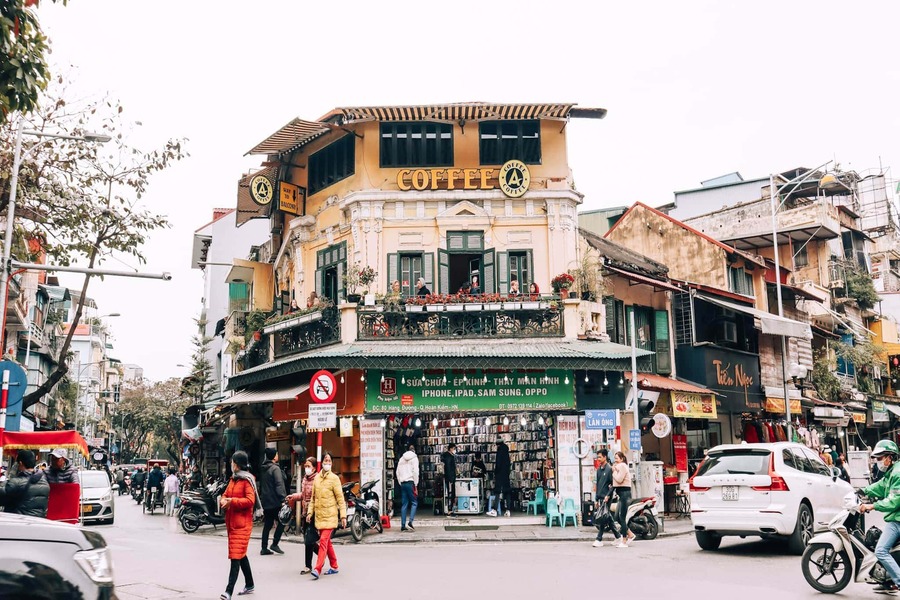
Hanoi is where most international travellers begin a Vietnam trip, and for good reason. The capital received more than 33.7 million visitors in 2026 – 2027, a 20.8% increase on the prior year, and was named Asia’s Leading City Destination and Asia’s Leading City Break Destination at the World Travel Awards 2026 – 2027. On TripAdvisor, Hanoi ranked second among the world’s top 25 cultural destinations globally — ahead of Rome, Kyoto, and Barcelona.
The city’s appeal is structural rather than dependent on any single attraction. The 36 streets of Hoan Kiem’s Old Quarter each historically specialised in a specific trade — silk, paper, tin goods — and the urban fabric of those medieval trading lanes has survived largely intact. The Temple of Literature, founded in 1070 as Vietnam’s first national university, is a functioning Confucian academy whose architecture draws direct parallels with China’s classical scholarly buildings but maintains a distinctly Vietnamese character in its proportions and decorative language.
For first-time visitors, three days in Hanoi is the practical minimum. Four days allows for a day trip to Ninh Binh’s Trang An Scenic Landscape Complex, 90 kilometres south — a UNESCO World Mixed Heritage site combining karst limestone formations, ancient temples, and boat cave passages that travel writers frequently describe as what Ha Long Bay would feel like if it were not crowded. Entrance by rowing boat costs approximately VND 200,000 per person.
Practical note: Hanoi’s peak visiting season runs October to April. The July and August window is hot, humid, and subject to periodic heavy rainfall, though the city remains fully operational and hotel rates drop significantly.
Ha Long Bay — Nearly 2,000 Islands and 500 Million Years of Geology
Ha Long Bay holds UNESCO World Natural Heritage status twice over — inscribed first in 1994, extended in 2000, and expanded again in 2023 to include the Cat Ba Archipelago in a combined designation covering 4,910 species of flora and fauna. The bay’s 1,969 limestone islands and islets rise from the Gulf of Tonkin across a total area of 1,553 square kilometres, formed through 500 million years of geological activity that has left hollow cave systems, vertical sea stacks, and submerged karst formations visible through water clarity that varies from jade green to deep emerald depending on season and light.
The practical challenge at Ha Long Bay is not whether to visit but how to visit it without a compromised experience. Day trips from Hanoi — a 3.5-hour drive each way — deliver approximately four hours on the water, which is not sufficient to reach the most scenic areas of the bay. Two days and one night on an overnight cruise is the standard recommendation, and it is correct: the second morning on the bay, after other day-trip boats have left, offers a quality of light and relative quiet that day visitors never access.
Cruise pricing ranges from VND 2,000,000 to VND 6,000,000 per person per night depending on operator category. The significant quality difference between budget and mid-tier operators makes this one of the trips in Vietnam where spending slightly more changes the experience substantially. Seaplane access from Hanoi has become an alternative for luxury travellers — the 45-minute flight over the karst formations before landing on Cat Bi Airport provides an aerial perspective that no boat can replicate.
For travellers who want the Ha Long Bay landscape without the visitor density, Bai Tu Long Bay sits immediately adjacent and receives a fraction of the traffic. The overnight cruise product there is less developed, but the scenery is identical and the boat-to-island ratio is dramatically more comfortable.
Tourist Places in North-Central Vietnam Worth Visiting
Ninh Binh — Ha Long Bay on Land
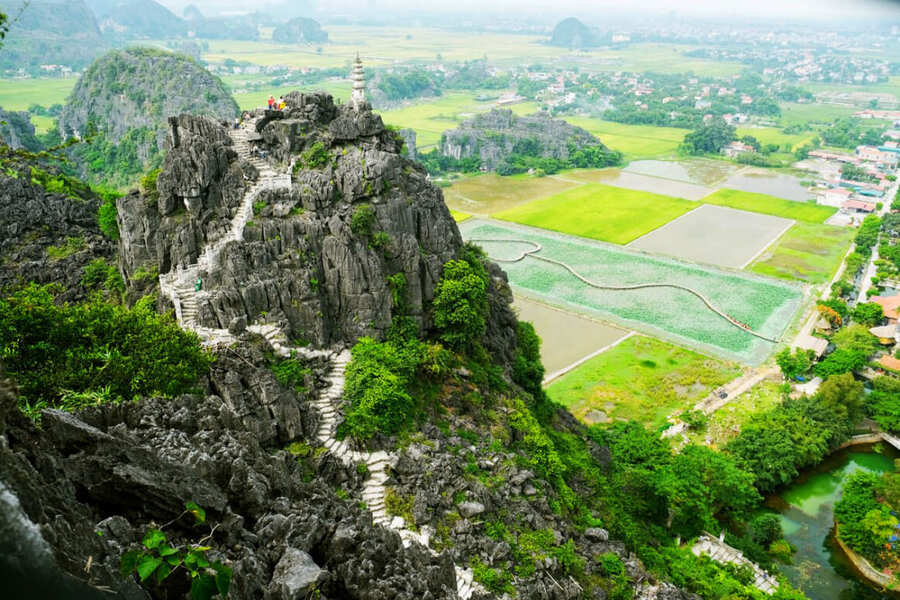
Ninh Binh is positioned 90 kilometres south of Hanoi and draws comparisons to Ha Long Bay because it shares the same geological DNA — limestone karst formations rising from flat terrain — but delivers the experience through a river delta and wetland landscape rather than open sea. The Trang An Landscape Complex, inscribed as Vietnam’s first UNESCO World Mixed Heritage Site in 2014, covers 6,172 hectares and combines natural karst scenery with archaeological evidence of human habitation stretching back 30,000 years.
The boat cave tours through Trang An are the defining experience. Small rowing boats, each steered by a local guide using both hands and feet, pass through a series of cave passages connecting open-air lagoons. The total circuit covers approximately 9 kilometres and takes two to three hours. The Van Long Nature Reserve, 30 kilometres further into the province, adds a wetland wildlife dimension with the Delacour’s langur — one of the world’s 25 most endangered primates — visible on the limestone cliff faces during early morning boat tours.
Two days is sufficient for a Ninh Binh visit that includes both Trang An and Van Long. The province is typically combined with Hanoi as part of the northern Vietnam leg rather than treated as a standalone destination.
Best Places to Visit in Central Vietnam with UNESCO Heritage Sites
Hue — The Imperial Capital That Rewards Slow Travel
Hue served as Vietnam’s imperial capital under the Nguyen Dynasty from 1802 to 1945, and the physical evidence of that history survives in an architectural complex that UNESCO listed as a World Cultural Heritage Site in 1993. The Imperial Citadel, built from 1805 onward, covers 6 square kilometres and was modelled on Beijing’s Forbidden City while incorporating Vietnamese architectural principles. The Perfume River winds through the city and past the royal tomb complexes of the Nguyen emperors, each built as a self-contained philosophical statement combining mausoleum, garden, ceremonial hall, and lake.
The most visited royal tomb is Khai Dinh’s, notable for its hybrid Vietnamese and European architectural vocabulary — concrete and stone rather than wood, with mosaic tilework covering every interior surface. Minh Mang’s tomb, set within a walled garden complex that took 12 years to construct, is considered architecturally purer and offers a more complete understanding of the Nguyen aesthetic philosophy.
Hue City welcomed approximately 238,200 international visitors during the 2026 Tet holiday period alone, a 207% increase on the prior year — the highest proportional growth of any major Vietnamese destination. That growth is partly driven by Hue’s direct flight connections, which have expanded, and partly by international recognition of the city as one of Southeast Asia’s most significant living heritage destinations.
Two nights in Hue is the minimum that allows for the Imperial Citadel, two royal tombs, Thien Mu Pagoda, and a Perfume River sunset boat ride. Three nights adds the option of day-tripping through the Hai Van Pass to Da Nang — one of Vietnam’s most scenic coastal road sections — with the full visual impact that the mountain-to-sea descent provides.
Da Nang — The Most Livable City in Vietnam
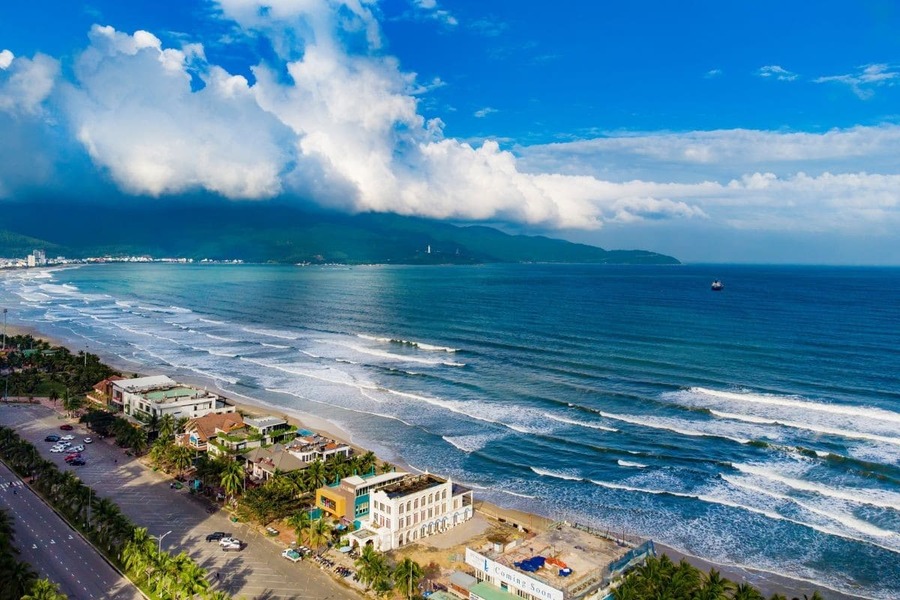
Da Nang is the central Vietnam destination that works hardest as a travel hub. It sits equidistant between Hue to the north and Hoi An to the south, has the region’s main international airport with direct connections to South Korea, Japan, China, Singapore, and Australia, and offers its own distinct attractions alongside the role it plays as a base for day trips in both directions.
The city’s own coastal assets — My Khe Beach, one of the longest urban beaches in Vietnam at over 30 kilometres, and Non Nuoc Beach at the foot of the Marble Mountains — draw travellers seeking beach time alongside cultural access. The Marble Mountains (Ngu Hanh Son) are five limestone peaks containing cave pagodas, Buddhist shrines, and viewpoints over the surrounding coastline. The name refers to the five elements — metal, wood, water, fire, earth — and each hill carries the Vietnamese name of its corresponding element.
Da Nang is also the gateway to the Ba Na Hills mountain resort, at 1,487 metres elevation, where the French-built Golden Bridge is supported by two giant stone hands in a design that became one of the most photographed structures in Vietnam almost immediately after its 2018 opening.
For golfers, Da Nang and its immediate surroundings contain more top-ranked golf courses than anywhere else in Vietnam — BRG Da Nang Golf Resort (Greg Norman and Jack Nicklaus courses), Montgomerie Links, Ba Na Hills Golf Club, and Hoiana Shores Golf Club all fall within 60 kilometres of the airport.
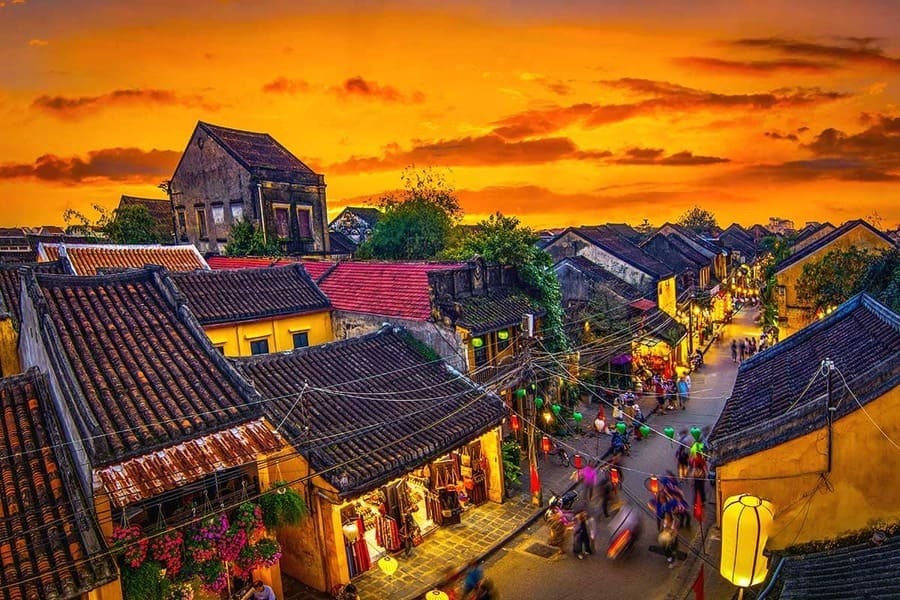
Hoi An Ancient Town — Vietnam’s Most Perfectly Preserved Historic Port
Hoi An is the destination that travellers most consistently name as their favourite stop in Vietnam, and the reason is not difficult to understand. The Ancient Town, listed as a UNESCO World Cultural Heritage Site in 1999, preserves the physical fabric of a 15th to 19th-century international trading port more completely than anywhere else in the region. Japanese merchant houses, Chinese assembly halls, French colonial shopfronts, and a 16th-century covered bridge built by the Japanese trading community in 1593 coexist within a compact area crossable on foot in under 20 minutes.
The town operates on a combined ticket system for its heritage buildings. A single ticket at VND 120,000 covers entry to five heritage sites from a list of categories. At night, the town transitions from a daytime heritage precinct to a lantern-lit atmospheric destination as electric lighting is reduced and thousands of silk and paper lanterns illuminate the streets and canal edges.
Hoi An is a functional town as well as a heritage site. The tailoring trade — which has operated here continuously since the trading port period — remains active, and dozens of workshops produce custom clothing in 24 to 48 hours from client measurements. Pricing is competitive relative to international standards and quality ranges from acceptable to excellent depending on the workshop.
Three nights is the recommended stay for a first visit. Two nights is manageable for the heritage town itself, but the third night opens access to My Son Sanctuary (50 kilometres inland), Cham civilisation tower ruins in a jungle valley that UNESCO listed in 1999 alongside Hoi An itself.
Top Tourist Spots in Southern Vietnam for City, Beach, and River Experiences
Ho Chi Minh City — Where Modern Vietnam Makes Itself Felt
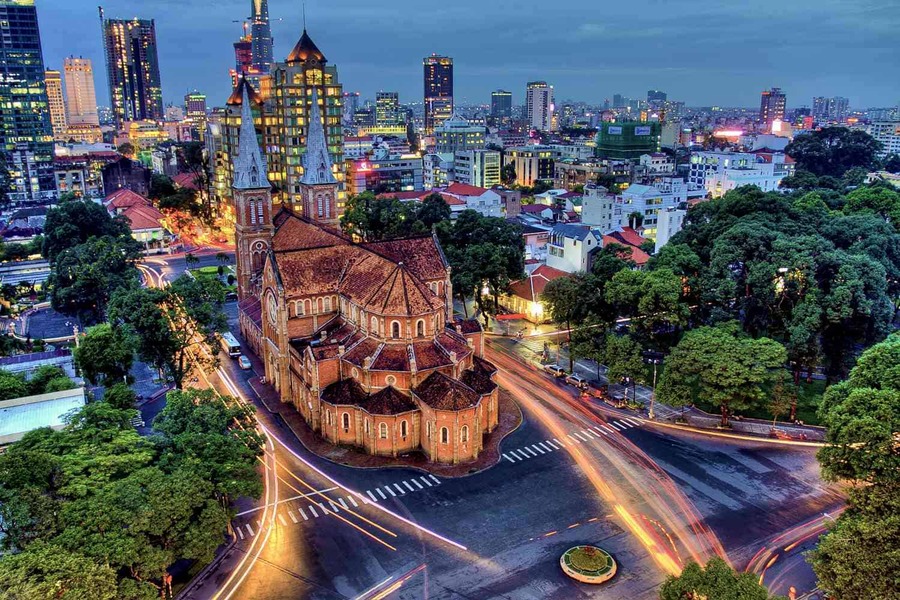
Ho Chi Minh City, still called Saigon by most of its 9 million residents, is Vietnam’s commercial capital and the entry point for the country’s southern region. As a tourist destination, it operates differently from Hanoi — less architectural heritage, more contemporary urban energy, and a street-level intensity of food, motorbike traffic, and commerce that takes a day or two to adjust to before becoming the appeal itself.
The essential sites are well known but worth the time. The War Remnants Museum contains the most extensively documented photographic and artefact record of the American War period available to the public anywhere in the world. The Cu Chi Tunnels, 40 kilometres northwest of the city in Cu Chi District, preserve a 250-kilometre underground network used by Viet Cong forces during the conflict. A guided visit takes two to three hours and includes the option to crawl through restored tunnel sections.
The city’s food culture is the most diverse in Vietnam. District 1 concentrates tourist-facing restaurants, but the better eating is in Districts 3, 4, and the Binh Thanh area, where banh mi breakfast from sidewalk vendors costs VND 20,000 to VND 30,000, com tam (broken rice with grilled pork) from market stalls is VND 40,000 to VND 60,000, and the afternoon drinking culture of bia hoi (fresh beer) street corners operates at VND 10,000 to VND 15,000 per glass.
Two full days covers the essential sites. Three to four days is sufficient to add a Mekong Delta day trip and a visit to the Ben Thanh Market area.
The Mekong Delta — River Life at the End of the Country
The Mekong River enters Vietnam from Cambodia and fans into nine distributaries across a delta region covering 39,000 square kilometres before reaching the South China Sea. The result is a landscape of interlocking canals, floating markets, fruit orchards, and river communities that has sustained one of the world’s most productive agricultural regions for centuries and now produces roughly half of Vietnam’s food supply.
Can Tho, the delta’s largest city, is the practical base. The Cai Rang Floating Market operates from approximately 5 AM to 9 AM on the river six kilometres from Can Tho’s city centre, wholesale in character — boats selling produce to other boats rather than to tourists — and photographically extraordinary in the early morning light. Arriving by small rowing boat rather than a motorised tourist vessel places visitors at water level with the market activity rather than above it, which is the correct approach.
Ben Tre Province, one hour from Can Tho, runs specialist cooking classes and sampan canal tours through coconut palm groves that represent the specific character of Mekong Delta travel at its most authentic.
Phu Quoc — Vietnam’s Premier Island Destination
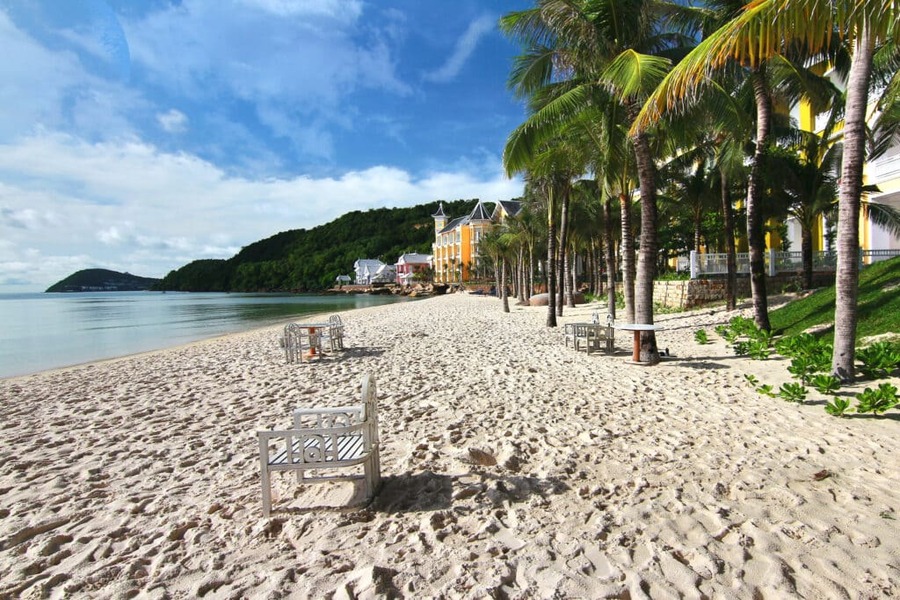
Phu Quoc is Vietnam’s largest island, located in the Gulf of Thailand approximately 50 minutes by plane from Ho Chi Minh City. Long Beach and Bai Sao in the south hold the island’s most photographed stretches of white sand and clear water, while Phu Quoc National Park covers more than 50% of the island’s interior in primary forest that provides hiking and wildlife observation opportunities distinct from the beach resort character of the development zone.
The island’s international profile has risen sharply since 2020. JW Marriott Phu Quoc Emerald Bay, Vinpearl Resort & Spa, and Regent Phu Quoc have established the accommodation offer at the top of Vietnam’s luxury market, and direct international flights now connect Phu Quoc with Bangkok, Singapore, and several Chinese cities.
Phu Quoc fish sauce is the island’s historically significant food product — produced through a 12 to 15-month fermentation process in large wooden barrels that has remained unchanged since the 18th century and earned a European Union Geographical Indication in 2012, the first Vietnamese agricultural product to receive EU GI protection. A visit to the Khai Hoan Fish Sauce Factory in Duong Dong town places the product in its production context.
Three to four days captures beach relaxation, the national park, and the town of Duong Dong. Five days allows for a dive or snorkel trip to the outer islands of the Hon Thom group.
How to Plan a Vietnam Trip Around the Best Tourist Places in Vietnam
Most travellers entering Vietnam for the first time have between 12 and 21 days. The itinerary structure that makes most efficient use of that time uses Hanoi and Ho Chi Minh City as the anchor points, connects them by domestic flight (under two hours, approximately $30 to $80 USD one-way), and builds the central Vietnam section around Da Nang as a hub.
A 14-day structure might allocate three nights in Hanoi with a Ninh Binh day trip, two nights at Ha Long Bay on an overnight cruise, two nights in Hue, three nights in Da Nang and Hoi An, and three nights divided between Ho Chi Minh City and either the Mekong Delta or Phu Quoc.
A 21-day structure adds capacity to slow down in Hoi An, add Con Dao Islands, extend the Mekong Delta visit to a two-night immersive programme, and include Phu Quoc as a dedicated island leg rather than a compressed addition.
Vietnam rewards the traveller who moves more slowly. The destinations in this guide are individually rich enough that rushing through them produces a fundamentally different experience from spending adequate time in each one.

0 Comment