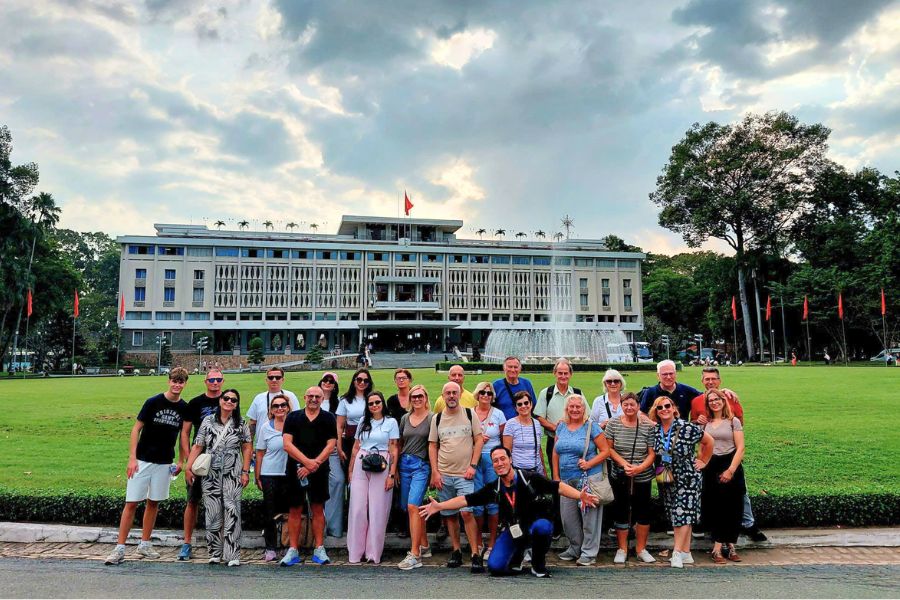

Picture a group of 28 guests landing in Da Nang in November, only to find that the coach cannot enter Hoi An’s pedestrian old town and nobody planned the drop-off point. Problems like this usually start long before arrival, at the moment an agency chooses its ground partner. This Vietnam DMC checklist gives travel agencies and tour operators 15 checks to run before signing, from licence verification to on-trip support. Use it to screen a new destination management company in Vietnam or to review the one you already work with.
The 15 Checks at a Glance
| Stage | Question it answers | Checks |
| 1. Legitimacy | Is the DMC real and licensed? | Licence, contracting entity, guides and vehicles |
| 2. Fit | Can the DMC serve my business? | Group type, source market, track record |
| 3. Quote | Is the price clear and comparable? | Itemisation, net or commissionable, peak dates |
| 4. Contract | Who carries the risk? | Payment terms, liability, change handling |
| 5. Before departure | Is everything ready on the ground? | Visas, seasonal routing, on-trip support |
Stage 1: Is the Vietnam DMC Legitimate?
Check 1: Does the DMC hold an international tour operator licence?
Vietnamese law makes a clear difference between a travel agency and a tour operator. A travel agency may only sell tours that a licensed operator runs, and earns a commission on each sale. Operating tourism services without the relevant licence is prohibited. Ask the DMC in Vietnam for its licence number (numbers typically end in “GP LHQT”), the issue date, and the scope, which should include inbound. Then check the number against the national tourism authority’s online business database, searching by registered company name. Brand names often differ from registered names. Licensed operators must also lodge a bank deposit, which is VND 250 million for inbound services under the current published procedure.
Check 2: Who signs the contract and receives your payment?
Confirm the exact legal entity that will sign your agreement and its tax code, registered address and office locations. The name on the bank account receiving your transfer should match the contracting company, not an individual. Ask which services the DMC runs itself and which it subcontracts. A good answer shows a named office city, local staff and a clear split between owned and subcontracted services. Mismatched names between brand, contract and bank account are the single most common warning sign in this stage.
Check 3: Are guides, drivers and vehicles licensed?
International tour guides in Vietnam must hold a guide card and demonstrate foreign language ability, with level 4 or higher on Vietnam’s 6-level language framework. Ask for the guide’s name, card number and working language for your dates. Ask which coach company supplies vehicles, whether it operates under a tourist transport licence, and how many seats each vehicle has. Request a backup guide plan for peak weeks, because guide availability tightens in high season.
Stage 2: Does the DMC Fit Your Business?
Check 4: Can the DMC handle your type of group?
FIT, group series and MICE need different skills. Look for reference work in your segment and candour about what the DMC does not do well. Group sizes in Vietnam range from 8 to 10 for FIT up to 40 or more for series and MICE, and each size changes coach choice, restaurant selection and guide ratios. Ask for a sample operations plan for a group the size of yours and for the number of departures the DMC runs per year in your segment.
Check 5: Can the DMC serve your source market?
Every source market brings different requirements. Ask about guide languages beyond English, dietary options such as vegetarian, Jain or halal meals, payment currencies, communication channels and time zone coverage. Ask whether vouchers and itineraries can carry your agency’s branding. The section “How Do Needs Differ by Source Market?” below lists typical differences.
Check 6: Can the DMC prove its track record?
Request two or three contactable references from agencies in your segment and ask whether invoices matched quotes and how problems were handled. Then run a small test. A small booking run end to end, including a modification, shows more than any brochure. For high-risk groups, a small live request or a paid planning stage is a sensible way to test the DMC before committing the full programme.

Stage 3: What Should a Vietnam DMC Quote Include?
Check 7: Is the quote itemised and complete?
A usable quote states hotel category, rooming basis, domestic flights, guide coverage, meals, gratuities, free places and currency assumptions. It should also list entrance fees, cruise costs if relevant, taxes and service charges, exclusions and cancellation terms. Common exclusions are international flights, visas and tips. Revised quotes should show what changed between versions. An itemised quote lets you compare total value instead of a headline number.
Check 8: Is the rate net or commissionable, and who owns the client?
Ask whether the price is net or commissionable and whether the DMC contacts your client directly. Put a non-circumvention clause in writing. When comparing DMCs, request quotes for identical specifications. A quote far below the others usually hides a downgraded hotel, a shared coach or missing entrance fees. Ask each DMC to explain any gap between its price and the rest.
Check 9: How does the DMC price peak dates and holidays?
Tet 2027 begins on Saturday, 6 February 2027, and the public-sector break runs from 4 to 10 February. National Day 2027 brings four consecutive days off, from 2 to 5 September. Private employers may choose among several schedules, so supplier closure dates vary. Ask for the surcharge schedule, minimum-stay rules and blackout dates in writing, with the exact percentage rather than “peak season supplement”.

Stage 4: Which Contract Terms Protect Your Agency?
Check 10: What are the payment and cancellation terms?
Confirm the deposit percentage, balance deadline, cancellation scale, refund timing, payment currency and who pays bank charges. Terms vary widely. One publicly published Vietnam example uses a 50% deposit at signing, with the balance due 14 days before arrival and refunds of 80%, 50% and 0% depending on how early the cancellation comes. Use such examples only as a reference point, not as a standard. Everything should be in writing and consistent with the contract.
Check 11: Who carries liability and insurance?
Ask for proof of liability insurance and confirm the cover includes your activities, such as adventure, water sports or coach transfers. Read the force majeure clause and ask what happens if a hotel overbooks or a cruise cancels for weather. Your clients should also hold their own travel insurance. Make that a requirement in your booking terms.
Check 12: Who decides when plans change?
Ask who reviews the route, contracts suppliers, briefs the guide and responds during travel. Request specific turnaround times for new quotes, mid-trip amendments and out-of-hours changes. Then ask for an example of handling a flight delay, hotel mismatch or weather change. Judge the answer by decisions made, not by reassurance. Written answers should state the challenged assumption, the responsible operator and the fallback still required.
Stage 5: What Must You Confirm Before Departure?
Check 13: Have you confirmed visas and entry rules for every passport?
The Vietnam e-visa is valid for up to 90 days, costs USD 25 for single entry and USD 50 for multiple entry, and takes 3 to 5 working days to process. Citizens of 25 countries, including Germany, France, Italy, Spain, the United Kingdom, Russia, Japan and South Korea, receive a 45-day visa exemption. Citizens of India, the United States, Canada, Australia and China are not on that list as of 2026, so those groups normally apply for e-visas. Passports should be valid for six months or more, and the e-visa names a specific entry checkpoint. Names must match the passport exactly. Mixed-nationality groups need a passport-by-passport check. A separate Phu Quoc island exemption also exists, so ask the DMC about current conditions. Apply early, because a typo on one visa can delay an entire group.
Check 14: Is the routing realistic for the season?
Central Vietnam sees heavy rain and flood risk in Hoi An’s old town between October and December. Drop-off points in Hoi An’s pedestrian centre must be planned in advance, and domestic flights between Hanoi, Da Nang and Ho Chi Minh City sell out early. Booking lead times of 8 to 12 weeks for peak months and 4 to 6 weeks off-peak are a practical guide from operators, not a legal rule. A same-day transfer from Ninh Binh to a bay can be tight, so ask for drive times for each leg and a weather backup plan.
Check 15: What does on-trip support and reporting look like?
Ask for a named 24/7 duty contact, a direct line, an escalation path and a real example of a past incident. Review the arrival flow for groups: signage, luggage, coach loading, early check-in, split arrivals and first-day pacing. Ask how the DMC checks in during the trip and what the post-trip report contains, including a final reconciliation of invoice against quote.
Which Red Flags Should Make You Walk Away?
- No licence number, or a number that does not match the company name
- Payment requested to a personal account
- A quote without itemisation, or unexplained price jumps between drafts
- Pressure to book quickly
- No contactable references
- Refusal of a small test booking
- No named 24/7 contact
- Vague answers about what is subcontracted
What Should Your Group Brief Include?
Copy this list and send it before any itinerary is locked:
- Agency name, source market and contact person
- Group size, adults and children, ages if relevant
- Travel dates and flexibility
- Nationalities and passport status
- Land budget per person per day
- Hotel category and rooming basis
- Meals and dietary needs
- Guide language
- Must-see and must-avoid items
- Mobility or special needs
- Domestic flight preferences
- Net or commissionable structure and payment currency
- Quote deadline and decision date
FAQ
What is the difference between a Vietnam DMC, a tour operator and a travel agency?
A DMC is a commercial label for a local ground specialist. In Vietnamese law, the licensed entity that can run inbound tours is the international tour operator, while a travel agency sells tours on behalf of operators for commission.
How can I check whether a Vietnam DMC is licensed?
Ask for the licence number, issue date and scope, then search the national tourism authority’s online database by the registered company name. The number typically ends in “GP LHQT”.
How far ahead should I book a Vietnam group?
Operators commonly advise 8 to 12 weeks for peak months and 4 to 6 weeks off-peak. For Tet 2027, request confirmation as early as your quote cycle allows.
Do my clients need a visa for Vietnam in 2026?
It depends on each passport. Nationals of 25 countries have a 45-day exemption, and everyone else can apply for an e-visa valid up to 90 days. Check each passport on the official list.
Should I use one DMC for all of Vietnam or several?
Both approaches work. Some advisors suggest not limiting yourself to one DMC per country, while others recommend starting with one regional DMC to build trust. Test first, then decide.
What if a DMC refuses a trial booking?
Treat it as a warning sign and ask why. A DMC confident in its operations has little reason to avoid a small test.
0 Comment